Subscribe if you want to be notified of new blog posts. You will receive an email confirming your subscription.
Google Health
Will Google Health Platformize the Electronic Health Record Market?
by Vince Kuraitis, Edward G. Anderson, and Geoffrey Parker
The COVID-19 pandemic has accelerated calls for the development of EHR 2.0 (electronic health record 2.0) – the next generation of EHRs with extended platform features and capabilities.
Who will answer this call? While existing EHR vendors have made modest efforts, the door is open for big tech companies and start-ups to develop functionality to envelop and disintermediate current EHRs. We highlight early efforts by Google Health Care Studio as having the potential to bring platform functionality to a sector of the healthcare industry known for resistance to change and innovation.
Read the full article in The Health Care Blog.

Is HITECH Working? #4: While most attention has been focused on demand side incentives (will doctors and hospitals buy EHRs?), the supply (vendor) side of HIT is already transforming.
by Vince Kuraitis JD, MBA and David C. Kibbe MD, MBA
Most of the press coverage and attention to HITECH has been to the “buy” side of the market: The central question here has been: “Will doctors and hospitals buy and use EHR technology?”
Meanwhile — and much more quietly — the sell (vendor) side of the EHR market is already dramatically different than it was a year ago. We observe change occurring at at least three levels:
HITECH […]

We’re Building a REALLY BIG Health Internet!
How big a network will the Health Internet (aka National Health Information Network) be?
My BOTE (back-of-the-envelope) calculation is that this network could consist of about 301 million nodes. Here’s my math (pls. clarify or amplify):
300 million individuals in U.S.
700 K doctors
5 K hospitals
295 K — other B2B healthcare entities
Very rough…but I hope you get the point.
So let’s put into perspective press releases from Google or Microsoft announcing that they have developed new “partnerships” (i.e.nodes in the network) for Google Health or Microsoft HealthVault. As an example, […]

What’s a Network Industry? Is Healthcare One?
This post is a foundational overview of characteristics of network industries. Much of the terminology will deserve deeper discussion, but we have to start somewhere.
In his book The Economics of Network Industries, Professor Oz Shy lists four characteristics of network industries.
The main characteristics of these markets which distinguish them from the market for grain, dairy products, apples, and treasury bonds are:
Complementarity, compatibility and standards
Consumption externalities [network effects]
Switching costs and lock-in
Significant economies of scale in production
In this essay, I’ll quote from Dr. Shy in explaining each […]
“Meaningful Use” Criteria as a Unifying Force
by Vince Kuraitis, Steve Adams, and David C. Kibbe MD, MBA
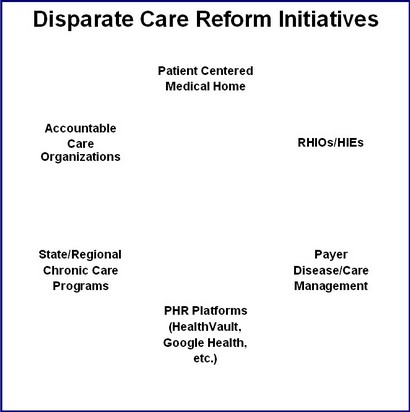
Over the past several years, many diverse initiatives have arisen offering partial solutions to systemic problems in the U.S. health care non-system.
We see Meaningful Use Criteria recommended by the HIT Policy Committee as a unifying force for these previously disparate initiatives. These initiatives have included:
Patient Centered Medical Homes (PCMHs)
Regional Health Information Organizations (RHIOs)/Health Information Exchanges (HIEs)
Payer Disease/Care Management Programs
Personal Health Record Platforms — Google Health, Microsoft HealthVault, Dossia, health banks, more to come
State/Regional […]
Microsoft HealthVault is a Serious Business Strategy. Will Google Health Become More than a Hobby?
Google Health…please stick around….but please also get your stuff together.
Over the past few days, several of my respected colleagues have written excellent blog posts essentially asking “Does Google Health have life?”
Scott Shreeve — CLEAR! Shocking Google Health Back to Life
John Moore — Is Google Health Irrelevant?
Will Crawford — Future of Google Health
I share their observations and sentiments. I see Microsoft HealthVault as a serious business strategy while Google Health is more like a hobby (one of probably hundreds at Google).
Are there reasons […]
Adieu, LifeCOMM
“Qualcomm pulls the plug on LifeComm” announced Brian Dolan of mobihealthnews recently.
As demonstrated by e-CareManagement blog readership, there has been a lot of interest in LifeCOMM. My first blog post on LifeCOMM in 2007 has been single the most commented on post and the second most widely read blog post.
It’s taken me a while to sift through my thoughts and feelings about saying “Goodbye” to LifeCOMM. At first I was deeply disappointed, but after further reflection think that LifeCOMM wasn’t the right […]
Time for EHRs to Become Plug-and-Play
by David C. Kibbe MD, MBA
The remarkable report, “Initial Lessons From the First National Demonstration Project on Practice Transformation to a Patient-Centered Medical Home,” published in the May/June issue of Annals of Family Medicine, the Nutting Report, makes this point about the state of primary care IT offerings:
Technology needed in a PCMH is not “plug and play.” The hodge-podge of information technology marketed to primary care practices resembles more a pile of jigsaw pieces than components of an integrated and […]

Privacy Law Showdown? Legal and Policy Analysis.
#2 in a series — Modifications to HIPAA Privacy Laws: Impact on Microsoft HealthVault, Google Health, and other PHRs.
by Deven McGraw JD, MPH, Center for Democracy & Technology
Introduction
There has been considerable discussion lately about whether or not the stimulus legislation (ARRA) extends HIPAA coverage to commercial vendors of personal health records (PHRs) any time they contract with entities already covered by HIPAA like hospitals, health plans or physicians groups. (For those of you who don’t know, HIPAA is the Health Insurance Portability and […]
Privacy Law Showdown? Setting the Stage
Today’s post is the first in a series entitled:
Modifications to HIPAA Privacy Laws: Impact on Microsoft HealthVault, Google Health, and other PHRs.
We’ll explore how recent changes in privacy provisions of ARRA/HITECH Federal stimulus legislation affect personal health information (PHI) platform companies (e.g., HealthVault, Google Health, Dossia) and personal health record (PHR) companies.
Health IT expert and journalist Neil Versel described the issue in the April 7 issue of BNET Healthcare:
Although Google and Microsoft have gotten plenty of attention for their Web-based personal health records, both companies have long […]