Subscribe if you want to be notified of new blog posts. You will receive an email confirming your subscription.
hospital

Which Platform of Platforms (UDHP) is Right for your Health System? A Market Analysis
By Neil P. Jennings and Vince Kuraitis
In previous posts in this series, we have covered the definitions of Unified Digital Health platforms and whether “EHRs can become UDHPs.” In this follow-on post, we’ll talk through the requirements for success for a UDHP and which types of healthcare organizations are best suited for which types of UDHPs. This post will build on findings from the previous posts.
The Market Needs UDHPs: Key Takeaways from Previous Posts
Key Takeaway 1: The healthcare industry needs UDHPs to create a centralized, common architecture for healthcare organizations
Key Takeaway 2: The healthcare organizations leveraging UDHPs will achieve a myriad of benefits, from competitive advantages to clinical, financial, and operational gains
Key Takeaway 3: UDHPs are not all-or-nothing or mutually exclusive from EHRs. As we explored in our last post, EHRs could expand into UDHPs. These EHRs as UDHPs (or the relative platform of platforms) may be the optimal choice for some market segments. EHRs may also be accommodated into cloud-first UHDPs.
Key Takeaway 4 / Guiding Criterion: This post will focus on US regional and local health systems and outpatient groups of all sizes.
The Approach: Market -> Segments -> Options -> Fit
- For this post, we will start from the top-down market perspective, analyzing the overall market landscape.
- Once we have described the landscape, we will call out the key segments (organization types, sizes, and profiles) that we will be evaluating.
- At this point, we will approximate IT budgets and IT team sizes by organization type to determine capabilities of building as opposed to depending on partners and vendors.
- Then, we’ll review the constraints for implementation and ownership, outlining the drivers of UDHP fit.
- Next, we’ll break down the different ways UDHPs can be developed and maintained.
- Leveraging an EHR as UDHP
- License from UDHP vendor
- “Home grown” cloud-first solution
- Finally, we’ll crosswalk the segments and the optimal option for each segment, based on their specific needs and estimated IT and budgetary resources.

WSJ Article on MD Referrals & Leakage: Beware of Premature Conclusions
The question we should be asking is “How can we best align the interests of patients, physicians and hospital systems in referral decisions?”
The answer sometimes might be to make a referral outside of the hospital system — but let’s not jump to premature conclusions.
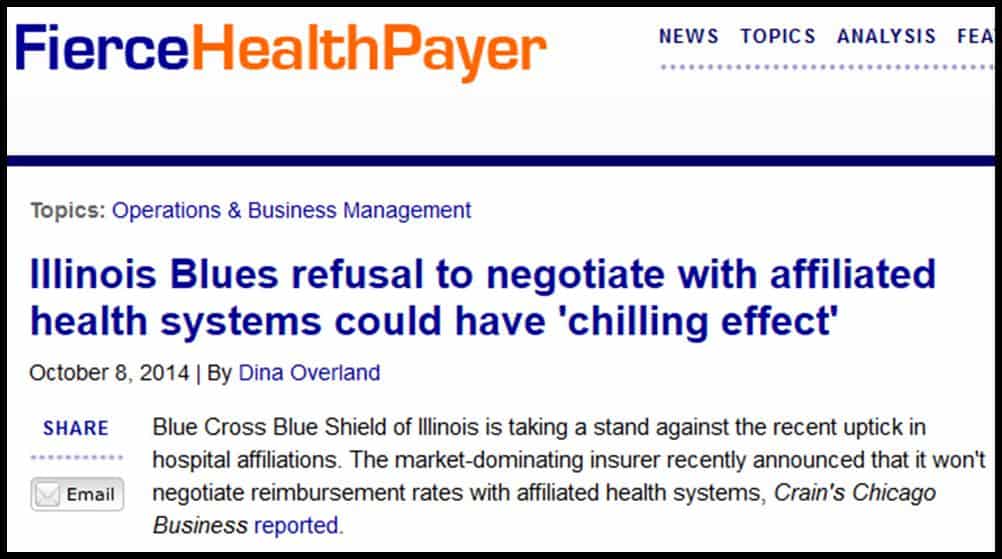
BCBSIL Refuses to Negotiate Jointly With “Affiliated” Providers. Now What?
Tensions between health plans and care providers have taken an fascinating turn in Chicago. Blue Cross Blue Shield of Illinois (BCBSIL) is refusing to allow care providers “affiliated” through a clinical integration agreement to negotiate contracts jointly.
The ramifications for future network contracts are significant and could play out very differently in other health care markets.
Background
In February 2014 Advocate Health Care and Silver Cross Hospital announced a clinical integration affiliation agreement. Advocate is the state’s largest hospital network and Silver Cross […]

Hospitals…Thinking About Getting Into Health Insurance? 6 Reasons To Lie Down Until the Urge Goes Away.
Greg Masters reports on a recent Kaiser Health News article: Hospitals Look to Become Insurers, As Well as Providers of Care”.
This is the dumbest idea I’ve heard since “I’m going to invest all my money in Facebook’s IPO and get rich!”
Here are six reasons why:

The Practice of Medicine: from Marcus Welby to ???
by Jaan Sidorov MD, MHSA, FACP and Vince Kuraitis JD, MBA
Physicians face great uncertainty. According to a survey conducted by The Physicians Foundation, the great majority of physicians (89%) believe the traditional model of independent private practice is either “on shaky ground” or “is a dinosaur soon to go extinct.”
In the face of this uncertainty, many physicians are jumping to a conclusion that “I have to sell my practice to the hospital.” In this post of our series on The […]
Physician-Hospital Relationships: The Hospital Morphs from Revenue Center to Cost Center
by Vince Kuraitis JD, MBA and Jaan Sidorov MD, MHSA, FACP
In our introductory posting of this series, we noted that economic incentives previously aligning doctor-hospital interests were changing. This creates the potential for The 100 Year Shift – physicians awakening to possibilities for stronger partnerships with payers than with hospitals.
In this post, we will zero in on the changing economic position of hospitals and the effect this is having on physician-hospital relationships. We will examine the […]
Will Health Plans Continue to Buy Up Hospitals?
I doubt it.
IMHO, the recent acquisition by Highmark Blue Cross Blue Shield of West Penn Allegheny Health System (WPAHS) for $475 M is unique to local market conditions. It was done as a last resort and should not be taken as a signal that health plans are starting a hospital buying binge.
Why are hospitals unattractive investments for health plans:
Trend Spotting: 1) Medicare ACO Dead-in-the-Water, 2) Payers Awaken to ACO Opportunities
It’s time to call it — the Medicare Shared Savings (SS) ACO is dead-in-the-water.
Ironically — at the same time — commercial payers are awakening to ACO opportunities.
Please read further.
Aetna, Cigna, Wellpoint Recreating Their Business Models
Major U.S. health insurers, including Aetna Inc., Humana Inc. and WellPoint Inc., are retooling to become more than just health plans, in the wake of the federal health-care overhaul that is changing the rules for the industry’s core business.
Diversification plans, touted in meetings with investors this year, include stepped up acquisitions and partnerships that will allow the companies to employ doctors directly, deliver health-information technologies, and participate in new hospital-doctor groups known as accountable-care […]

BlogTalkRadio Interview — Is Hospital-Physician Alignment Sustainable?
Why have hospitals increasingly been buying physician practices? Are these marriages based on true love or convenience? Will these marriages survive?
To address these questions, let’s take the long view (50–100 years) and revisit 7 assumptions that have driven us to today’s healthcare non-system:
Healthcare payment systems have rewarded piecemeal work.
Despite uneasiness, hospital-physician relationships have been cooperative.
Physicians can function effectively in small/medium size practices.
The healthcare mindset: built on control, not collaboration.
Barriers to sharing patient info and coordinating care are high.
The hospital has been the economic bedrock […]