Healthcare is fragmented…
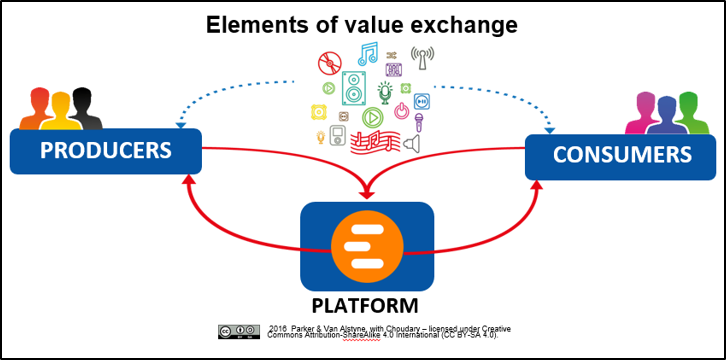
Platforms make connections and facilitate interactions…
Platforms are more than just technology.
Advising on
Healthcare strategy & business models for AI, platforms, digital health & ecosystems
Subscribe if you want to be notified of new blog posts. You will receive an email confirming your subscription.
The Healthcare Platform Blog formerly e-CareManagement Blog
Strategy & Business Models • Chronic Care • Technology • Policy
Your Company Has A Technology Platform…But Do You Have A Platform Business Model and Strategy?
Today in healthcare, platforms are understood mostly as technology. That’s not wrong, but it’s limiting and it misses a huge opportunity to adopt a platform business model.
In most other industries platforms are also understood as a business model and strategy. Outside of healthcare, there are 45+ books focusing on this topic.
This post is written for:
- 9,000+ early-stage digital health companies, most of which have a software and/or hardware technology platform as a centerpiece of their offering
- Healthcare incumbents — health systems, health plans, pharma, medical devices, etc. — that provide a digital platform as part of their external offering. For example, health systems that have an EHR platform, a patient portal, and/or a population health platform.
What Do Platforms Do?
Value-Based Care Needs an Operating Layer, Not Another Point Solution
Guest post by Lalit Kundu, Co-Founder & CTO, Pelica Health
Value-based care runs on a simple bet: an organization takes financial responsibility for a population’s health and keeps the savings if it can hold costs down. The organizations making that bet, physician-led IPAs, ACOs, Medicare Advantage groups, and the health plans they contract with, all run the same kind of back office to deliver on it. A small operations team, often eight to ten people, owns the daily work for the whole population: closing care gaps, capturing diagnoses, reaching the members who need attention.
On a typical day, that team can be accountable for more than 100,000 patients. When it falls behind, the instinct is to add headcount. But two more coordinators don’t move a panel that size. The constraint isn’t people, and it isn’t insight. These teams already know which members need attention; the gap list is the one thing they’re never short of.
The constraint is everything that happens after the list is generated. Someone still has to make the calls, work the callbacks, key the data into payer portals, and chase the follow-up. A coordinator can spend 30 to 40 minutes per member on that coordination alone before a single unit of care moves. That is where value-based care quietly bleeds.
In this essay, I will:
- Show why point-solution fatigue bites hardest in value-based care operations, where small teams own enormous panels against a hard regulatory clock
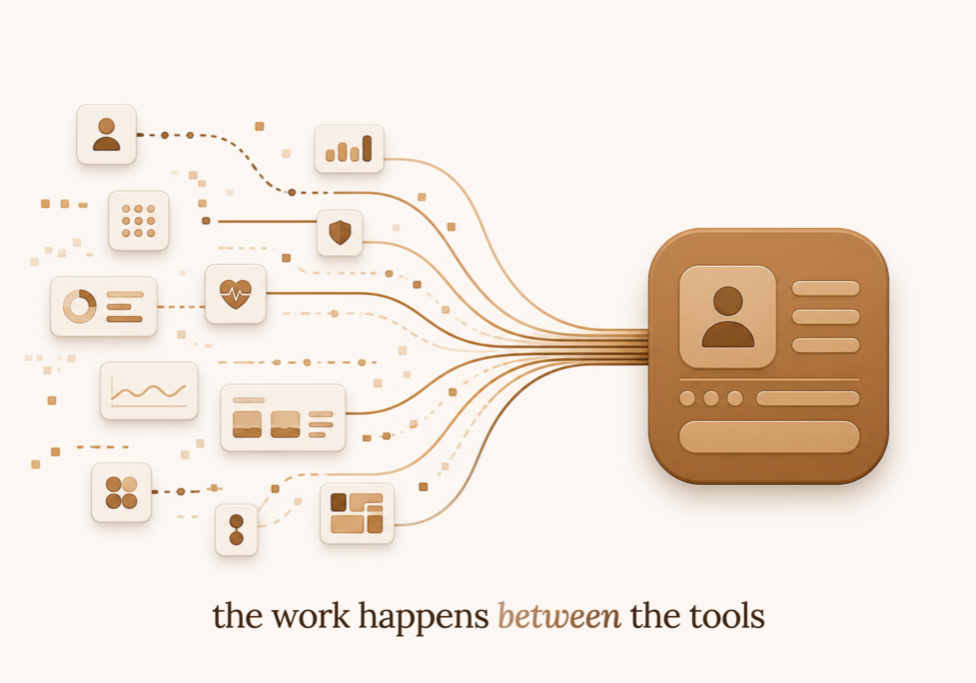
- Argue that the fix is a shared operating record the whole team acts on, not one more screen to read
- Explain why bolting a copilot onto every dashboard keeps the fragmentation and only adds AI to it
- Offer a test you can run on any “VBC platform” to tell a real operating layer from a well-integrated pipe, and be honest about which network effects this category actually has
Which Platform of Platforms (UDHP) is Right for your Health System? A Market Analysis
By Neil P. Jennings and Vince Kuraitis
In previous posts in this series, we have covered the definitions of Unified Digital Health platforms and whether “EHRs can become UDHPs.” In this follow-on post, we’ll talk through the requirements for success for a UDHP and which types of healthcare organizations are best suited for which types of UDHPs. This post will build on findings from the previous posts.
The Market Needs UDHPs: Key Takeaways from Previous Posts
Key Takeaway 1: The healthcare industry needs UDHPs to create a centralized, common architecture for healthcare organizations
Key Takeaway 2: The healthcare organizations leveraging UDHPs will achieve a myriad of benefits, from competitive advantages to clinical, financial, and operational gains
Key Takeaway 3: UDHPs are not all-or-nothing or mutually exclusive from EHRs. As we explored in our last post, EHRs could expand into UDHPs. These EHRs as UDHPs (or the relative platform of platforms) may be the optimal choice for some market segments. EHRs may also be accommodated into cloud-first UHDPs.
Key Takeaway 4 / Guiding Criterion: This post will focus on US regional and local health systems and outpatient groups of all sizes.
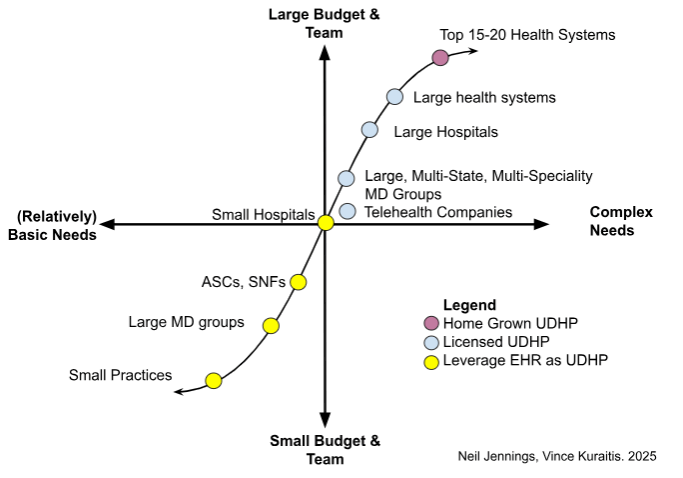
The Approach: Market -> Segments -> Options -> Fit
- For this post, we will start from the top-down market perspective, analyzing the overall market landscape.
- Once we have described the landscape, we will call out the key segments (organization types, sizes, and profiles) that we will be evaluating.
- At this point, we will approximate IT budgets and IT team sizes by organization type to determine capabilities of building as opposed to depending on partners and vendors.
- Then, we’ll review the constraints for implementation and ownership, outlining the drivers of UDHP fit.
- Next, we’ll break down the different ways UDHPs can be developed and maintained.
- Leveraging an EHR as UDHP
- License from UDHP vendor
- “Home grown” cloud-first solution
- Finally, we’ll crosswalk the segments and the optimal option for each segment, based on their specific needs and estimated IT and budgetary resources.
EXPERTISE IN PLATFORM STRATEGY & BUSINESS MODELS

Vince Kuraitis JD, MBA
Vince brings 30+ years’ healthcare executive and consulting experience across more than 150 organizations. Clients have included tech companies, hospitals, physician groups, IT, medical devices, pharma, health plans, disease management home health, and others. Vince received his graduate degrees at UCLA.

More than 12 years ago, Intel started a long journey to help build a consumer health ecosystem that would enable true patient empowerment and responsibility, care to the home and community, and personalized treatment using mobile devices and next generation diagnostics. With our many projects over the years, Vince has been far more than a just another consultant. He has become a confidant and collaborator—almost part of the Intel family—in helping to shape the wide range of investments we have made. From launching our early research on apps/wearables for independent living and chronic disease management…to initiating new conferences, standards organizations, and public policy initiatives to make way for personal health…to internal product and business plans we have developed, Vince has brought a careful, quiet, detailed wisdom that has helped us avoid the hype cycles of consumer health and to stay the course towards building an open, innovative ecosystem that is becoming more and more real by the day.
Eric Dishman, General Manager, Intel Health Strategy & Solutions Group