Subscribe if you want to be notified of new blog posts. You will receive an email confirming your subscription.
Care Providers & Care Coordination
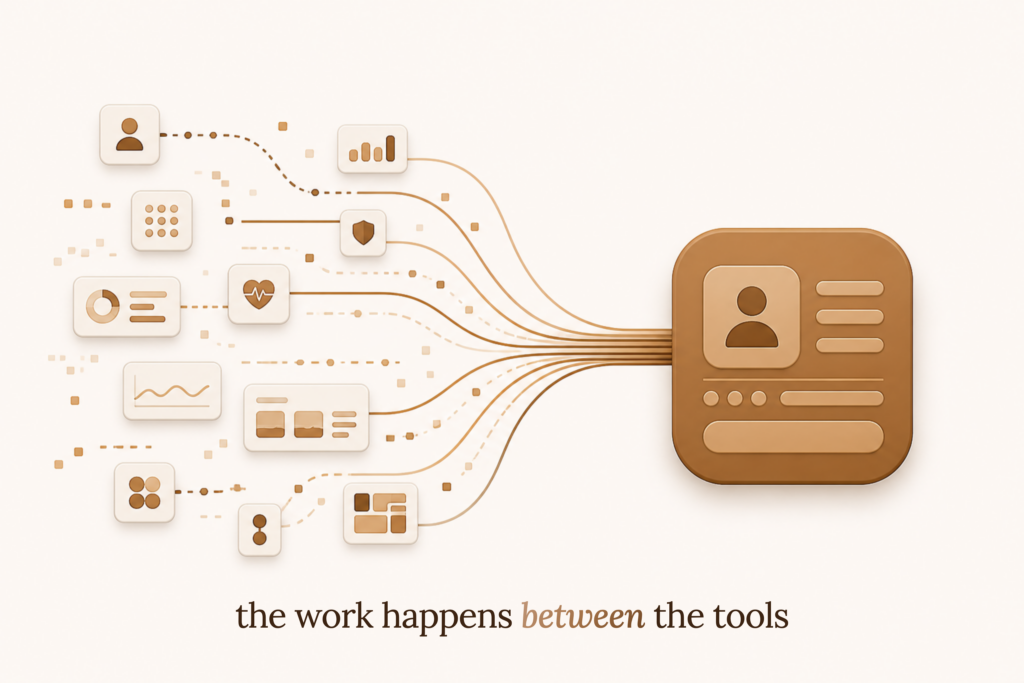
Value-Based Care Needs an Operating Layer, Not Another Point Solution
Guest post by Lalit Kundu, Co-Founder & CTO, Pelica Health
Value-based care runs on a simple bet: an organization takes financial responsibility for a population’s health and keeps the savings if it can hold costs down. The organizations making that bet, physician-led IPAs, ACOs, Medicare Advantage groups, and the health plans they contract with, all run the same kind of back office to deliver on it. A small operations team, often eight to ten people, owns the daily work for the whole population: closing care gaps, capturing diagnoses, reaching the members who need attention.
On a typical day, that team can be accountable for more than 100,000 patients. When it falls behind, the instinct is to add headcount. But two more coordinators don’t move a panel that size. The constraint isn’t people, and it isn’t insight. These teams already know which members need attention; the gap list is the one thing they’re never short of.
The constraint is everything that happens after the list is generated. Someone still has to make the calls, work the callbacks, key the data into payer portals, and chase the follow-up. A coordinator can spend 30 to 40 minutes per member on that coordination alone before a single unit of care moves. That is where value-based care quietly bleeds.
In this essay, I will:
- Show why point-solution fatigue bites hardest in value-based care operations, where small teams own enormous panels against a hard regulatory clock
- Argue that the fix is a shared operating record the whole team acts on, not one more screen to read
- Explain why bolting a copilot onto every dashboard keeps the fragmentation and only adds AI to it
- Offer a test you can run on any “VBC platform” to tell a real operating layer from a well-integrated pipe, and be honest about which network effects this category actually has
Hotspotting, Superutilizers, and Avoiding “RTM Traps”
Be wary of falling into an RTM Trap when working with superutilizers. RTM can be especially pronounced in this group of patients.

WSJ Article on MD Referrals & Leakage: Beware of Premature Conclusions
The question we should be asking is “How can we best align the interests of patients, physicians and hospital systems in referral decisions?”
The answer sometimes might be to make a referral outside of the hospital system — but let’s not jump to premature conclusions.
ACO Lessons Learned: Revisiting the Timing of Downside Risk
The editor and publisher of Accountable Care News have been generous in allowing me to republish my article from the November 2014 issue.
Click here to download a .pdf copy of the article. It’s in-depth — about 2,000 words.
Here’s the article in a nutshell:
One of the most critical aspects of the Medicare Shared Savings Program (MSSP) ACO has been around the timing and certainty of requiring mandatory downside financial risk for physician and hospital participants. Provider protests cajoled CMS […]
BCBSIL Refuses to Negotiate Jointly With “Affiliated” Providers. Now What?
Tensions between health plans and care providers have taken an fascinating turn in Chicago. Blue Cross Blue Shield of Illinois (BCBSIL) is refusing to allow care providers “affiliated” through a clinical integration agreement to negotiate contracts jointly.
The ramifications for future network contracts are significant and could play out very differently in other health care markets.
Background
In February 2014 Advocate Health Care and Silver Cross Hospital announced a clinical integration affiliation agreement. Advocate is the state’s largest hospital network and Silver Cross […]

Are Hospital Business Models on a Burning Platform? Not Yet, But It’s Inevitable.
From reading recent headlines, one might easily get the impression that hospitals are resistant — or at least ambivalent — in their pursuit and adoption of accountable care initiatives.
Are Hospitals Dragging their Feet on Accountable Care?
Commonwealth Fund: “only 13 percent of hospital respondents reported participating in an ACO or planning to participate within a year”
KPMG Survey: “(only) 27 percent of [health system] respondents said current business models were either not very or not at all sustainable over the next five […]
Physicians Shouldn’t Wait for Big Data: “Small Data” Can Jumpstart Your Care Management Program
by David C. Kibbe MD, MBA and Vince Kuraitis JD, MBA
Everywhere we turn these days it seems “Big Data” is being touted as a solution for physicians and physician groups who want to participate in Accountable Care Organizations, (ACOs) and/or accountable care-like contracts with payers. We disagree, and think the accumulated experience about what works and what doesn’t work for care management suggests that a “Small Data” approach might be good enough for many medical groups, while being more immediately […]
Hospitals…Thinking About Getting Into Health Insurance? 6 Reasons To Lie Down Until the Urge Goes Away.
Greg Masters reports on a recent Kaiser Health News article: Hospitals Look to Become Insurers, As Well as Providers of Care”.
This is the dumbest idea I’ve heard since “I’m going to invest all my money in Facebook’s IPO and get rich!”
Here are six reasons why:

The ACO Antitrust Police — Nothing to Do
One of the biggest concerns about ACOs has been their potential to enable market consolidation— that by uniting health care providers the ACO gains market clout and ability to charge higher prices.
While this is a legitimate concern about ACOs, so far it’s not playing out.
Why?
Leavitt ACO Report: Overstating or Understating Accountable Care Activity?
Accountable Care Organizations (ACOs) have been likened to
a unicorn — a fantastic creature that is vested with mythical powers. But no one has actually seen one.
a camel — a horse designed by a committee, one that already has its nose in the tent
With this background, you can begin to appreciate the difficulty of conducting an accurate census of ACO animals in the wilderness. Yet, this is exactly the task undertaken in the excellent Leavitt Partners report measuring ACO activity in the US.
As I […]