Subscribe if you want to be notified of new blog posts. You will receive an email confirming your subscription.
Information & Communication Technologies (ICT)

PR Blunder of the Year: Federation of American Hospitals Says Meaningful Use Should Not Tie to Quality Improvement
These guys really don’t get it, and they need to be called on the carpet, taken to the woodshed, or pick your own favorite cliche.
The Federation of American Hospitals (FAH) sent a letter to Dr. David Blumenthal (National Coordinator for Health IT) arguing that “Meaningful Use” funding should not be tied to achievement of quality measures. The FAH is the trade association for for-profit hospitals; the letter is dated August 26 and a copy is available on […]

What’s a Network Industry? Is Healthcare One?
This post is a foundational overview of characteristics of network industries. Much of the terminology will deserve deeper discussion, but we have to start somewhere.
In his book The Economics of Network Industries, Professor Oz Shy lists four characteristics of network industries.
The main characteristics of these markets which distinguish them from the market for grain, dairy products, apples, and treasury bonds are:
Complementarity, compatibility and standards
Consumption externalities [network effects]
Switching costs and lock-in
Significant economies of scale in production
In this essay, I’ll quote from Dr. Shy in explaining each […]

HIT Policy Committee Recommends “Minimum” Certification of EHRs
At last Friday’s meeting, the HIT Policy Committee adopted the recommendations of the Certification and Adoption Workgroup.
Between the initial recommendations in July and the adopted recommendations in August, one critical word was added to the definition of “certification”. That one word is “minimum” — and this one word expresses the correct approach and philosophy for the government’s role in the certification process for EHRs.
In this post I’ll address why a “minimum” approach toward certification makes […]
“Meaningful Use” Criteria as a Unifying Force
by Vince Kuraitis, Steve Adams, and David C. Kibbe MD, MBA
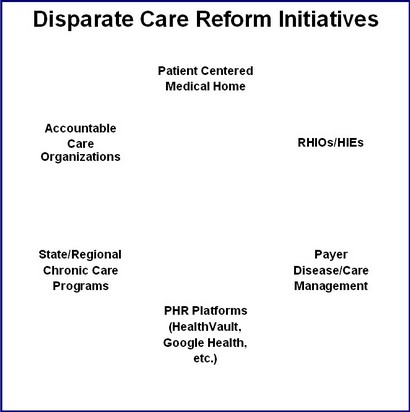
Over the past several years, many diverse initiatives have arisen offering partial solutions to systemic problems in the U.S. health care non-system.
We see Meaningful Use Criteria recommended by the HIT Policy Committee as a unifying force for these previously disparate initiatives. These initiatives have included:
Patient Centered Medical Homes (PCMHs)
Regional Health Information Organizations (RHIOs)/Health Information Exchanges (HIEs)
Payer Disease/Care Management Programs
Personal Health Record Platforms — Google Health, Microsoft HealthVault, Dossia, health banks, more to come
State/Regional […]

Microsoft HealthVault is a Serious Business Strategy. Will Google Health Become More than a Hobby?
Google Health…please stick around….but please also get your stuff together.
Over the past few days, several of my respected colleagues have written excellent blog posts essentially asking “Does Google Health have life?”
Scott Shreeve — CLEAR! Shocking Google Health Back to Life
John Moore — Is Google Health Irrelevant?
Will Crawford — Future of Google Health
I share their observations and sentiments. I see Microsoft HealthVault as a serious business strategy while Google Health is more like a hobby (one of probably hundreds at Google).
Are there reasons […]

Overcoming The Penguin Problem: Setting Expectations for EHR Adoption
Economists call it “The Penguin Problem” — No one moves unless everyone moves, so no one moves.
The role of user expectations is crucial in getting penguins to move off of ice floes and in the successful adoption of new network technologies. I’ll cover two main points in today’s essay:
How “The Penguin Problem” Helps Explain Low EHR (electronic health record) Adoption To-Date
How Recent Federal Actions Are Setting Higher Expectations for EHR Adoption
The Penguin Problem and Low EHR Adoption To-Date
While not the only factor, […]
Adieu, LifeCOMM
“Qualcomm pulls the plug on LifeComm” announced Brian Dolan of mobihealthnews recently.
As demonstrated by e-CareManagement blog readership, there has been a lot of interest in LifeCOMM. My first blog post on LifeCOMM in 2007 has been single the most commented on post and the second most widely read blog post.
It’s taken me a while to sift through my thoughts and feelings about saying “Goodbye” to LifeCOMM. At first I was deeply disappointed, but after further reflection think that LifeCOMM wasn’t the right […]
RHIOs Emerging From Coma
A subtle but profound shift is occurring in the world of RHIOs/HIEs (Regional Health Information Organizations/Health Information Exchanges).
…and the title of the eHealth Initiative’s Sixth Annual Survey of Health Information Exchange says it all:
Migrating Toward Meaningful Use
What’s happening here?

Geek Wisdom: “Interoperability” Must Include Process Collaboration
I know — you’re thinking that using “geek” and “wisdom” in the same sentence is an oxymoron. Bear with me — I’m trying to make a really important point in today’s posting.
Interoperability has multiple dimensions — and I’d bet that most of us have never thought of interoperabilty as involving “process” — people working together and collaborating; I know I hadn’t.
The Interoperability Work Group of HL7’s Electronic Health Record (EHR) Technical Committee was formed in April 2005 to attempt to define […]

Joe the Doctor: “…’scuse me, why do I want to bet-my-practice on an EMR?”
Blogger Fred Pennic writes a review of the (HIMSS) Healthcare Information and Management Systems Society 2008 Book of the Year Award. The book is entitled Keys to EMR Success: Selecting and Implementing an Electronic Medical Record and is written by Ronald Sterling, CPA, MBA.
There is no question,” says Sterling “that the selection and implementation of an EMR is a ‘bet-the-practice’ proposition. If you fail, you end up with more costs and greater frustration.…” (emphasis added)