Subscribe if you want to be notified of new blog posts. You will receive an email confirming your subscription.
“Meaningful Use” Criteria as a Unifying Force
by Vince Kuraitis, Steve Adams, and David C. Kibbe MD, MBA
Over the past several years, many diverse initiatives have arisen offering partial solutions to systemic problems in the U.S. health care non-system.
We see Meaningful Use Criteria recommended by the HIT Policy Committee as a unifying force for these previously disparate initiatives. These initiatives have included:
- Patient Centered Medical Homes (PCMHs)
- Regional Health Information Organizations (RHIOs)/Health Information Exchanges (HIEs)
- Payer Disease/Care Management Programs
- Personal Health Record Platforms — Google Health, Microsoft HealthVault, Dossia, health banks, more to come
- State/Regional Chronic Care Programs (e.g., Colorado, Pennsylvania, Improving Performance in Practice)
- Accountable Care Organizations — the newest model being proposed as part of national reform efforts
Today
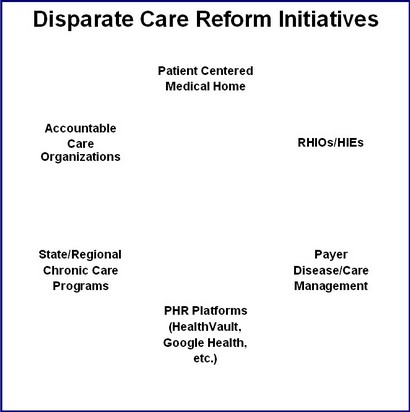
While there are some commonalities and overlap, to-date these initiatives have mostly arisen in isolation and are highly fragmented — they’re all over the map. Here’s a graphic representation of the fragmentation that exists today:
Tomorrow
The HIT Policy Committee recently recommended highly detailed Meaningful Use criteria for certified EHRs. Doctors and hospitals who hope to receive HITECH Act stimulus funds will have to demonstrate that they are meeting these criteria; the criteria are not yet finalized.
The Committee website describes the central role of the Meaningful Use criteria:
The focus on meaningful use is a recognition that better health care does not come solely from the adoption of technology itself, but through the exchange and use of health information to best inform clinical decisions at the point of care.
The HIT Policy Committee also is recognizing that there are multiple routes to achieving Meaningful Use beyond the traditional EMR 1.0, e.g., modular Clinical Groupware software.
While some might view the Meaningful Use criteria as limited to the world of health IT — something happening “over there” — we see much more going on. We believe the Meaningful Use criteria are becoming a powerful unifying force across the health system, with potential to converge previously disparate initiatives. Here’s our conceptual representation:

Let’s consider a couple examples to demonstrate how convergence is occurring.
RHIOs were formed primarily with a mission of developing health IT infrastructure for local data exchange; they had little need to think about how care providers, health plans and others would actually use the data.
Patient Centered Medical Homes have been built around seven principles (e.g., physician directed medical practice, care coordination) — none of which directly relate to a need to develop health IT infrastructure; the fact that IT infrastructure is necessary to implement these principles has been assumed but not defined.
RHIOs focused on health IT with little thought about objectives, while PCMHs had grand objectives with little thought about needs for health IT.
All this is changing.
RHIOs are recognizing that achieving meaningful use of data is essential; PCMH initiatives are recognizing the need for a robust IT infrastructure and the need to match their efforts to Meaningful Use criteria.
Here are some broader implications about Meaningful Use criteria becoming a unifying force:
- These diverse initiatives will have more commonalities and will look more and more alike
- Expect previously disconnected regional initiatives to start talking to one another about collaboration.
- A common phrase we are hearing is “We need to do a crosswalk of Meaningful Use criteria with our initiative/organization/application functionality.”
- Vendors must ask: “What are we doing to contribute to Meaningful Use of EHRs”
- Care providers (doctors and hospitals) must ask: “How are vendor offerings helping us to achieve Meaningful Use of EHRs?”
These are positive developments. Meaningful Use criteria are becoming a powerful unifying force toward integrating our fragmented health system.
This work is licensed under a Creative Commons Attribution-Share Alike 3.0 Unported License. Feel free to republish this post with attribution.
“Meaningful Use” Criteria as a Unifying Force (Vince Kuraitis): http://bit.ly/W6ORn
I agree completely.
The key to making the meaningful use criteria a unifying force will be interoperability standards. Once all of these programs can exchange data, we will have meaningful use and we will have a unified health care system.
Can "Meaningful Use" unify disparate solutions to systemic problems in U.S. health care? http://bit.ly/W6ORn (via e-CareManagement)
RT @pioneerrwjf Can "Meaningful Use" unify disparate solutions to systemic problems in U.S. health care? http://bit.ly/W6ORn
Meaningful use criteria as a unifying force . . .http://bit.ly/1ArHw4 #meaningfuluse #healthIT
RT @meaningfulHIT: Meaningful use criteria as a unifying force . . .http://bit.ly/1ArHw4 #meaningfuluse #healthIT
Nice post. Seem tree on most accounts but I also think that today medical practitioners are looking to avail of this federal incentive by trying to comply with the definition of meaningful use but at the same time EHR providers are looking at their own set of profits.
This misunderstanding is mostly I believe as a result of wrong interpretation of the federal guidelines. The EHR providers need to look at these guidelines from the prospective of the practitioners who deal with different specialties.
Each specialty EHR has its own set of challenges or requirements which I believe is overlooked by in most EHR vendors in a effort to merely follows federal guidelines. This is resulting in low usability to the practitioners, thus less ROI, finally redundancy of the EHR solution in place.
I think ROI is very important factor that should be duly considered when look achieve a ‘meaning use’ out of a EHR solution. Though one may get vendors providing ‘meaning use’ at a lower cost, their ROI / savings through the use of their EHR might be pretty low when compared to costlier initial investment. Found a pretty useful ROI tool that is pretty customizable and easy to use. It also accounts for the different specialty EHR’s too.
Some of the other useful resources on this topic:
REC’s putting EHR’s to meaningful use
Certification criteria for EHR
Also the introduction of REC’s through the HITECH act. is a great way to avail of quality EHR solutions at competitive prices. The stiff competition among not only these REC’s but also among EHR vendors ( to become a preferred vendor of a given REC) will result in lot of positives to medical practioners.
Looking the funding provided to the REC’s, the staggered grant allocation system also promises to be an unbiased way of allocating funds. It will also help in the concept of REC’s helping out each with their own unique business models. It can be one of the possible answers to the
’safe vendor challenge’ as discussed by many critics.
That is an interesting perspective on meaningful use. I hope it has that unifying effect, although my gut says it may have the opposite effect. What if it makes things even more complicated because everybody has their own interpretation of how to accomplish meaningful use and thus messes it up for all. Only time will tell.