Subscribe if you want to be notified of new blog posts. You will receive an email confirming your subscription.
Medicare
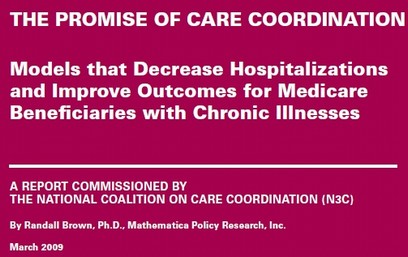
Landmark Report: “The Promise of Care Coordination” in Medicare
Download a copy here . Excerpts from the Executive Summary:
Effective Interventions
Three types of interventions have been demonstrated to be effective in reducing hospitalizations for Medicare beneficiaries with multiple chronic conditions who in general are not cognitively impaired:
Transitional care interventions in which patients are first engaged while in the hospital and then followed intensively over the 4 – 6 weeks after discharge
Self-management education interventions that engage patients for 4 -7 weeks in community-based programs designed to “activate” them in […]

Obama Budget: Hospitals Should Warrantee Admissions for 30 Days
Warrantee
War`ran*tee", noun. A written assurance that some product or service will be provided or will meet certain specifications.
Today when we buy practically any consumer item we expect a warrantee.
What’s the “warrantee” after you are discharged from a hospital?
Last September I wrote a post posing the question “What’s the Best Way to Get Hospitals Involved in Care Coordination? ” The short answer was: Pay them to do it, take money away when they don’t — make hospitals accountable for their […]

Spider Webs of Care Coordination Networks
We have learned that coordinating care of patients — particular care of Medicare patients — is complex and time consuming for physicians.
A breakthrough study quantifies just how complex and challenging care coordination really is. The study is reported in the February 17 issue of Annals of Internal Medicine and is entitled Primary Care Physicians’ Links to Other Physicians Through Medicare Patients: The Scope of Care Coordination :
We found that in a single year for just fee-for-service Medicare patients, the typical primary care physician needs […]

Why Clinical Groupware May Be the Next Big Thing in Health IT
by David C. Kibbe MD, MBA
What would you call health care software that:
Is Web-based and networkable, therefore highly scalable and inexpensive to purchase and use;
Provides a ‘unified view’ of a patient from multiple sources of data and information;
Is designed to be used interactively – by providers and patients alike – to coordinate care and create continuity;
Offers evidence-based guidance and coaching, personalized by access to a person’s health data as it changes;
Collects, for analysis and reporting, quality and performance measures as […]

Complimentary Issue — Medical Home News
Would you like to receive a complimentary issue of a new publication — Medical Home News ? Click on the link and then on “Sample Issue” in the upper left corner.
Here’s a preview of the first issue:
Introducing Medical Home News
An Annotated Guide to the Medicare Medical Home Demonstration (MMHD)
Subscriber’s Corner
Johns Hopkins Lipitz Center to Assist Practices in Medical Home Demo
National Medical Home Summit to be Held March 2nd – 3rd 2009
Thought Leader’s Corner
Industry News
Catching Up With… Paul Grundy, MD
I’m honored […]

Medicare Health Support: 8 Takeaways on Building Better Bridges
by Thomas Wilson, PhD, DrPH and Vince Kuraitis
What’s the right metaphor for Medicare Health Support (MHS), CMS’ major experiment with disease management for Medicare beneficiaries? We prefer to look it as a bridge failure that presents an opportunity to improve future engineering and design.
We’ve now had the time to read, reread, and reread again the very recent report from Research Triangle Institute (RTI) — Evaluation of Phase I of the Medicare Health Support Pilot Program Under Traditional Fee-for-Service Medicare: […]

JAMA Article Asks: What About “The Other Medical Home”?
Dr. Steven H. Landers writes a thoughtful article in today’s JAMA . He asks why the term Medical Home doesn’t include the patient’s home:
“…the Medical Home initiative, as currently articulated, ironically fails to emphasize the complex chronically ill patient’s actual home. This represents a failure to recognize the profile of the highest-risk beneficiaries driving much of the high Medicare costs—that is those with or more chronic conditions and activity limitations…
“A promising way to strengthen and broaden the Medical Home initiative […]

CMS Releases 2nd Report on Medicare Health Support
by Vince Kuraitis and Thomas Wilson, PhD, DrPH
CMS has just released the 2nd Report to Congress evaluating the Medicare Health Support (MHS) program. MHS is Medicare’s most visible and significant demo focusing on chronic disease management.
We’ve been poring over the report and will provide more detailed analysis and implications later this week. This 2nd Report to Congress covers 18 months of data on this 3 year project. It provides far more details and substantiation than RTI’s first report, which only covered 6 […]
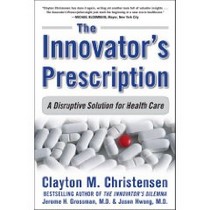
“The Innovator’s Prescription”: Christensen’s Book Offers Insightful Dx, Unrealistic Rx
by Vince Kuraitis and David C. Kibbe MD, MBA
Being big fans of Clay Christensen and his theory of disruptive innovation (DI), we have been awaiting his just-released book The Innovator’s Prescription: A Disruptive Solution for Healthcare . The book is co-authored by Dr. Jerome Grossman and Dr. Jason Hwang.
We have mixed reactions.
The book is mistitled. It should have been titled "The Innovator’s Diagnosis". The book does a fantastic job at diagnosis (Dx) of problems in the U.S. health care […]
Complimentary Webinar on Comparative Effectiveness Sponsored by Population Health Impact Institute (PHII)
The message is clear from Washington – “Comparative Effectiveness” has been proposed as the foundation for coverage decisions in Medicare. As the feds lead – this will more than likely "trickle down" to the commercial sector.
The Population Health Impact Institute (PHII) has convened national experts to develop a practical, comparative-based system to help purchasers and payers evaluate the methods and results used in all kinds of population health management programs – including medical, case and disease management, benefit design, value-based […]