Subscribe if you want to be notified of new blog posts. You will receive an email confirming your subscription.
Health Policy/Reform

HIT Policy Committee Recommends “Minimum” Certification of EHRs
At last Friday’s meeting, the HIT Policy Committee adopted the recommendations of the Certification and Adoption Workgroup.
Between the initial recommendations in July and the adopted recommendations in August, one critical word was added to the definition of “certification”. That one word is “minimum” — and this one word expresses the correct approach and philosophy for the government’s role in the certification process for EHRs.
In this post I’ll address why a “minimum” approach toward certification makes […]
“Meaningful Use” Criteria as a Unifying Force
by Vince Kuraitis, Steve Adams, and David C. Kibbe MD, MBA
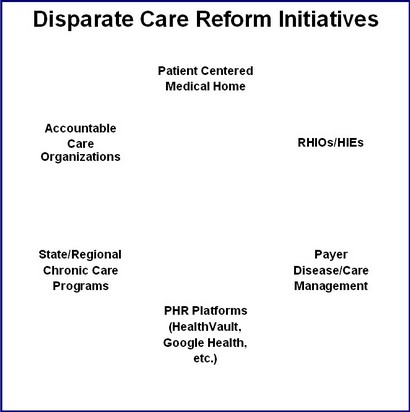
Over the past several years, many diverse initiatives have arisen offering partial solutions to systemic problems in the U.S. health care non-system.
We see Meaningful Use Criteria recommended by the HIT Policy Committee as a unifying force for these previously disparate initiatives. These initiatives have included:
Patient Centered Medical Homes (PCMHs)
Regional Health Information Organizations (RHIOs)/Health Information Exchanges (HIEs)
Payer Disease/Care Management Programs
Personal Health Record Platforms — Google Health, Microsoft HealthVault, Dossia, health banks, more to come
State/Regional […]

Medicare Medical Home Demo (MMHD) is in BIG Trouble
Between the time the MMHD was authorized in 2006 and now, we’ve learned a lot about what works and what doesn’t work in Medicare care coordination programs. The MMHD is between a rock and a hard place — conflicted by two “must achieve” objectives that are diametrically opposed:
As a political matter, the MMHD must save money
As currently structured, the MMHD cannot save money
Please read my guest post
The Medicare Medical Home Demonstration (MMHD): Between a Rock and a Hard Place
over at […]
Blueprint for Change: From EMR 1.0 to Clinical Groupware (EHR 2.0)
by Vince Kuraitis JD, MBA and David C. Kibbe MD, MBA
The last article in this series — Time for EHRs to Become Plug-and-Play — used words to describe a major industry shift underway in health IT.
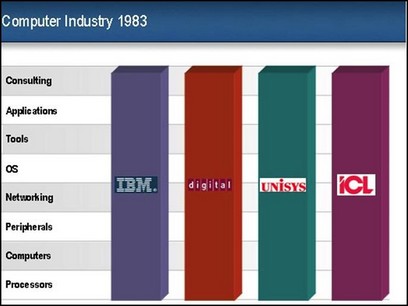
Sometimes pictures help to make a point. Here are several diagrams that you can also download as PowerPoint slides.
Computer Industry 1983 to 2002
Source: Venkatraman, N. Winning in a Network Centric Era, 2006
Blueprint for Health IT Shift
From EMR 1.0 — 2008…
…to Clinical Groupware/EHR 2.0 — 2012

Incentive to Innovate: Giving Health Reform a Rocket Boost
by Scott Shreeve, MD
We are entering an unprecedented season of change for the United States health care system. Americans are united by their desire to fundamentally reform our current system into one that delivers on the promise of freedom, equity, and best outcomes for best value. In this season of reform, we will see all kinds of ideas presented from all across the political spectrum. Many of these ideas will be prescriptive, and don’t harness the power of innovation to […]
Time for EHRs to Become Plug-and-Play
by David C. Kibbe MD, MBA
The remarkable report, “Initial Lessons From the First National Demonstration Project on Practice Transformation to a Patient-Centered Medical Home,” published in the May/June issue of Annals of Family Medicine, the Nutting Report, makes this point about the state of primary care IT offerings:
Technology needed in a PCMH is not “plug and play.” The hodge-podge of information technology marketed to primary care practices resembles more a pile of jigsaw pieces than components of an integrated and […]
Hope for Primary Care … from a Payer? A White Paper on the Collaborative Payer Model
by Tom Doerr, MD and Randy Bak, MD, JD
What if the health care payer were re-imagined as a service to the primary care doctor – supplying the tools, information and funding primary care physicians needed to meet the call to reform health delivery?
The structure of physician payment is considered one of the most problematic aspects of our health care system. Driven by volume instead of coordinated, proactive care and favoring procedures over cognitive work, the payment system has driven primary […]

Markle v. HIMSS: Differing Views of “Meaningful Use” and “Certification”
The forthcoming definition of the “meaningful use” of health information technology will set the direction of the Obama administration’s strategy for health IT adoption, said David Blumenthal, the new national coordinator for health IT. Government HealthIT, April 28, 2009
…but not everyone sees eye-to-eye on the definitions of “meaningful use” and “certification”. [See the first […]

Privacy Law Showdown? Legal and Policy Analysis.
#2 in a series — Modifications to HIPAA Privacy Laws: Impact on Microsoft HealthVault, Google Health, and other PHRs.
by Deven McGraw JD, MPH, Center for Democracy & Technology
Introduction
There has been considerable discussion lately about whether or not the stimulus legislation (ARRA) extends HIPAA coverage to commercial vendors of personal health records (PHRs) any time they contract with entities already covered by HIPAA like hospitals, health plans or physicians groups. (For those of you who don’t know, HIPAA is the Health Insurance Portability and […]
Privacy Law Showdown? Setting the Stage
Today’s post is the first in a series entitled:
Modifications to HIPAA Privacy Laws: Impact on Microsoft HealthVault, Google Health, and other PHRs.
We’ll explore how recent changes in privacy provisions of ARRA/HITECH Federal stimulus legislation affect personal health information (PHI) platform companies (e.g., HealthVault, Google Health, Dossia) and personal health record (PHR) companies.
Health IT expert and journalist Neil Versel described the issue in the April 7 issue of BNET Healthcare:
Although Google and Microsoft have gotten plenty of attention for their Web-based personal health records, both companies have long […]