Subscribe if you want to be notified of new blog posts. You will receive an email confirming your subscription.
Expertise in Platform Strategy & Business Models
The New Rules of Healthcare Platforms: APIs Enable the Platforming of Healthcare
by Vince Kuraitis, Brendan Keeler, and Jody Ranck
Recent regulations have mandated the use of HL7 FHIR APIs (application programming interfaces) to share health data. The regs apply to healthcare providers, payers, and technology developers who participate in federal programs. Many incumbent healthcare organizations are viewing these mandates as a compliance burden. That’s short-sighted. We recommend a more opportunistic POV.
APIs facilitate the sharing of health data across different devices and platforms. By adopting APIs, healthcare organizations can transform themselves from traditional service providers into powerful platforms that can connect patients, providers, and other stakeholders in new and innovative ways.
This blog post is the fourth in the series on The New Rules of Healthcare Platforms. In this essay, we explore the many benefits of API adoption for healthcare organizations and the key considerations that must be taken into account when implementing APIs:
- Healthcare’s Data Inflection Point
- APIs Enable Platform Business Models
- Barriers, Challenges, Reality Check

Creating a New Healthcare Podcast — The Platform Revolution in Healthcare
“Creating a New Healthcare” by Zeev Neuwirth, MD is an amazing podcast series. “The Platform Revolution in Healthcare” is the topic that Randy Williams, MD and I were privileged to discuss as guests.
Listen to this episode of Creating a New Healthcare!
Here’s a SUMMARY from Dr. Neuwirth’s show notes:
The topic of this episode is about an emerging healthcare marketplace transformation, which is the introduction of platforms into healthcare.
What surprised me about this movement is how many years it’s been developing. For example, last July I attended the 2022 MIT Platform Strategy Summit. Turns out it was their 10th annual symposium on this topic.
The first day was dedicated to healthcare and entitled, ‘The Platform Revolution Comes to Healthcare’. The opening presentation was entitled, Healthcare Platform Megatrends: Discovering the Power of Network Effects. [Slides and Video are available]
Our two podcast guests delivered that presentation. It was the most lucid and engaging explanation I’ve ever heard on the topic.…
Part II: Uber Health is More Than Just a Transportation Platform
Vince Kuraitis and Dr. Randy Williams talked with Caitlin Donovan, the Global Head of Uber Health, and Dr. Michael Cantor, the Chief Medical Officer of Uber Health, to learn more about Uber’s healthcare arm.
Part I of the interview summary covered 1) how Uber Health functions and how it supports the care of populations, and 2) how Uber Health harnesses network effects.
In today’s Part II, you will learn 1) why Uber launched Uber Health, and 2) how Uber Health manages opportunities and challenges presented by software and workflow integration.
Continue reading to understand how Uber Health is so much more than a transportation platform!
Why Did Uber Launch Uber Health? A Discussion of Platform Envelopment Strategies.

Part I: Uber Health is More Than Just a Transportation Platform
Recently, Vince Kuraitis and Dr. Randy Williams sat down with Caitlin Donovan, the Global Head of Uber Health, and Dr. Michael Cantor, the Chief Medical Officer of Uber Health, to learn more about Uber’s healthcare arm.
The interview is covered in two blog posts. In Part I, you will learn 1) how Uber Health functions and how it supports the care of populations, and 2) how Uber Health harnesses network effects.
Continue reading to understand how Uber Health is so much more than a transportation platform!
Meet Uber Health
Vince Kuraitis:
Our first question–simply describe Uber Health. What is it, who do you serve, and what are the various value propositions?
Caitlin Donovan:
I’m hoping that most of your readers know and use Uber. Think of Uber as the app that’s on your phone, in your pocket that allows you to request a ride somewhere or a delivery of something to you. Uber Health builds on those core competencies of Uber–the ability to move people, places and things–but takes an approach that allows us to think of many folks in the population as opposed to individuals requesting on their own behalf.

The New Rules of Healthcare Platforms: Platform Thinking Expands from “Technology” to Business Model & Strategy
by Vince Kuraitis, JD/MBA and Randy Williams, MD
Today in healthcare, platforms are understood mostly as “technology”. That’s not wrong, but it’s limiting. We want to offer you a more expansive view of platforms, and in turn, understand platforms as being more than just technology.
This post is the third in our series on The New Rules of Healthcare Platforms. In this essay, we will:
- Explain why platform business models are NOT new
- Share a survey of health plan execs that documents a view of platforms as “technology”
- Explain how network effects are the North Star of platform business models and strategy
- Expand your view of platforms beyond just “technology”
Platform Businesses are Not New
Platforms facilitate connections.
While digital technologies have turbocharged platforms, platform business models are not new. Here are some examples:
- Bazaars, shopping malls, swap meets, auctions: connecting buyers and sellers
- Magazines, newspapers, broadcast TV, radio: connecting readers, viewers, and listeners with advertisers
- Credit cards: connecting retailers and cardholders
- Real estate multiple listing services: connecting sellers and brokers
- In healthcare, the National Resident Matching Program: connecting medical graduates with residency programs

The New Rules of Healthcare Platforms: Pipe Scale vs. Platform Scale
Platform businesses scale differently than traditional businesses. Platforms scale through network effects.
In the previous post, we introduced and described a widely used metaphor: pipes vs. platforms.
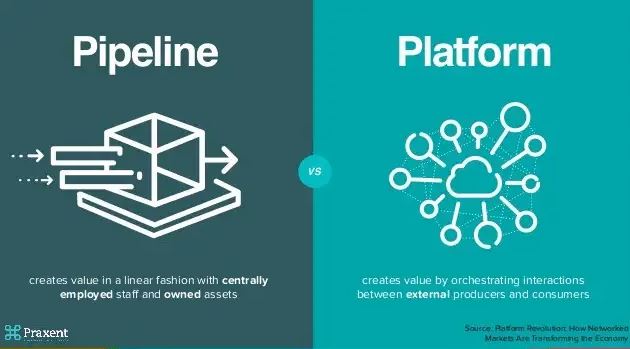
- Traditional businesses are pipes. Their value chains are linear. Value is added at sequential stages before a final product or service is delivered to consumers at the end of the pipeline.
- Platforms do not produce goods or services themselves—they make connections among stakeholders and facilitate value exchange among those stakeholders. Value is created outside the platform.
Both pipeline businesses and platform businesses strive to achieve scale—but the type of scale they strive for is vastly different. In this post, we’ll explain how pipeline businesses strive for economies of scale (on the supply side) and how platform businesses scale through network effects (on the demand side).
Pipe Scale–Economies of Scale (Supply Side)
In the industrial economy, businesses scaled through traditional economies of scale–higher volumes of output lead to lower costs of production per unit.
The New Rules of Healthcare Platforms: Value Creation Shifts from Pipes to Platforms
by Vince Kuraitis and Randy Williams
Value for customers is created differently on platforms than by traditional product/service business models. Today we’ll present and discuss the metaphor of how traditional businesses can be thought of as “pipelines” and how these pipes differ from digital platforms.
A New Series
This post is the first in a new series: “The New Rules of Healthcare Platforms.” We’ll be writing about platform thinking, new mental models, and the new economics of platform business models and strategy. We’ll have at least seven posts to explain these new rules.
You’ll have some unlearning to do. We’ll illustrate how platform business models are fundamentally different than traditional product/service business models. To understand platforms, we need to change more than just our thinking—we need to learn new rules about how the digital world works and how platforms fit in.
From Pipes to Platforms
Traditional product or service businesses can be described as pipelines. Their value chains are linear—see the diagram below. Value is added at sequential stages before a final product or service is delivered to consumers at the end of the pipeline.

The Missing Ingredient in Today’s Patient Portals: Network Effects
by Vince Kuraitis and Jody Ranck
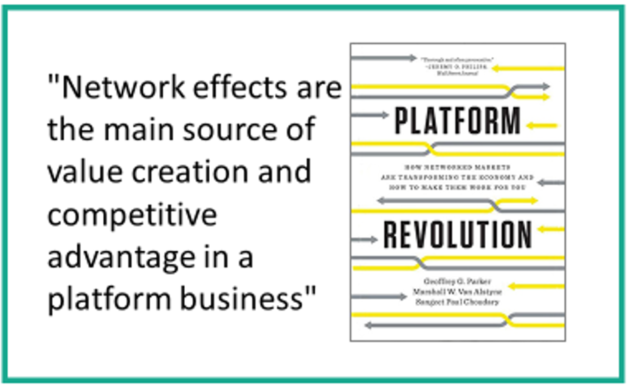
As described in the first three posts in this series, today’s patient portals are inherently flawed and doomed to mediocrity. The result is that today’s patient portals cannot achieve a critical mass of adoption and utilization, and therefore portals can’t achieve network effects.
In this post, we will:
- Summarize key points from the first three posts in this series
- Explain how today’s patient portals miss out on three types of network effects
- Explain the implications: why tomorrow’s portals must be reconfigured to achieve network effects
Summarizing
Let’s review some of the key points from the first three posts in this series.
Patients would prefer one portal “home” (from the 1st post in this series):
By definition, today’s portals are NOT patient-centric—they are tethered to individual provider organizations.
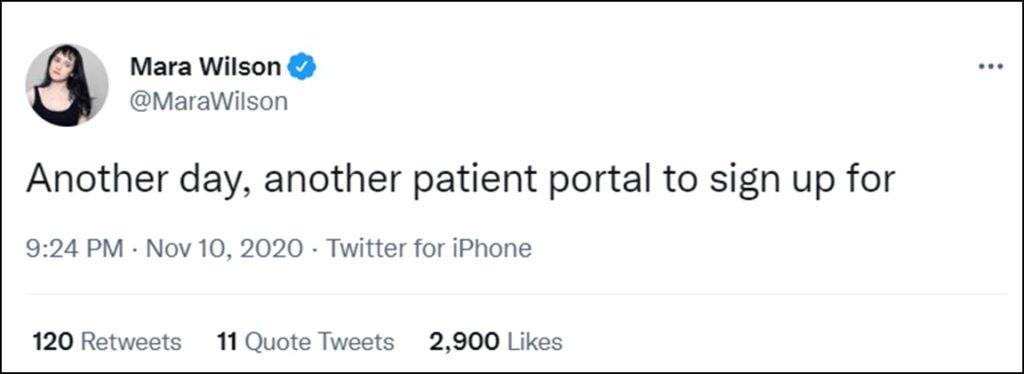
Today’s Patient Portals CAN NOT Work: Friction ACROSS Portals
by Vince Kuraitis and Jody Ranck
Friction across multiple patient portals dramatically limits their usefulness—there’s no practical way for patients OR providers to reconcile and integrate information and workflow.
This is the third post in our series on patient portals. We’ve used platform terminology and concepts to explain why today’s patient portals are doomed to mediocrity. Let’s recap:
The first post in this series introduced the platform terminology of single-homing vs.multihoming. Patients strongly would prefer to have as few portals as possible — ideally one, i.e., a single “home”.
The second post described the difference between stand-alone value and network value. Today’s patient portals can provide some stand-alone value, but they provide minimal network value.
In this post we’ll discuss the pitfalls of friction across multiple portals. Your mom having seven portals is more than just inconvenient—it’s dangerous.
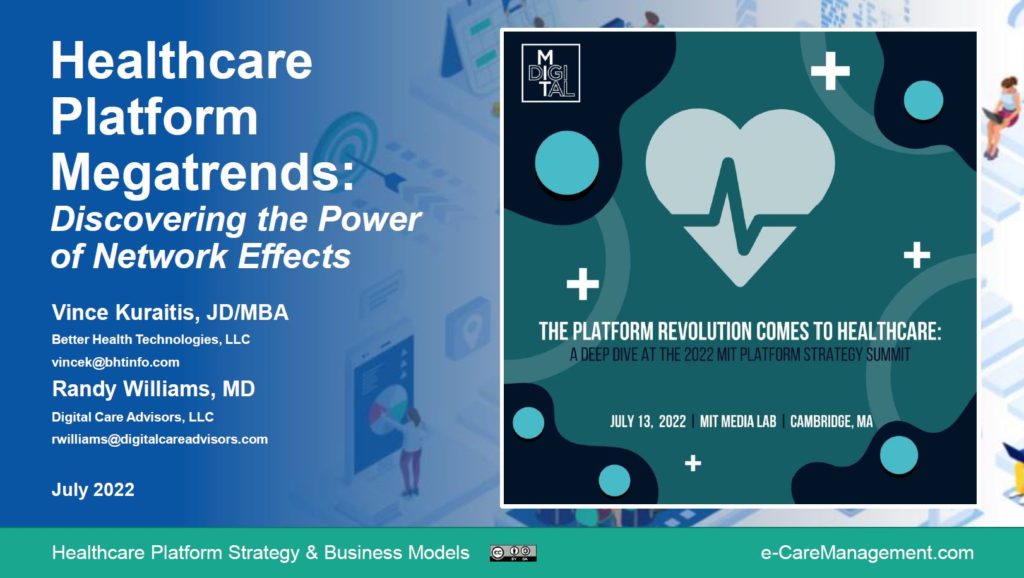
Healthcare Platform Megatrends Presentation at MIT: Slides and Video
by Vince Kuraitis and Randy Williams
We were honored to give the keynote presentation at the MIT Initiative on the Digital Economy event: “The Platform Revolution Comes to Healthcare”.
Here’s a brief summary:
Digital platforms are powerful. 7 of the 10 most valuable companies in the world are powered by platforms.
But…healthcare is late. Today in healthcare digital platforms are understood mostly as a technology construct. That’s not wrong, but it is severely limiting.
Tomorrow, platforms will be understood as central to operational and business strategy. Healthcare is just discovering network effects —the single biggest differentiator in platform success.