Subscribe if you want to be notified of new blog posts. You will receive an email confirming your subscription.
Patient Portal #FAIL
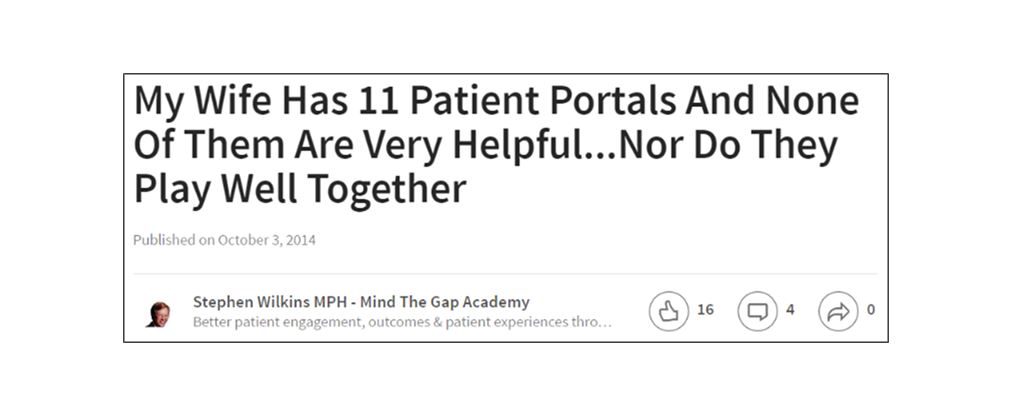
Platform Terminology Explains Why Today’s Patient Portals CAN NOT Work
“…the patient portal, as currently architected, is a complete dead-end.”
—John Moore, Founder and Managing Partner, Chilmark Research
Patient portals have tremendous potential — but that potential has not been realized and *CAN NOT* be realized as portals are currently configured.
An understanding of platform business models and strategy explains why today’s patient portals are inherently suboptimal.
This essay is the first in an occasional series that will look at patient portals through the lenses of platform business models and strategy. Today’s post will introduce and explain platform terminology of multihoming and single homing. Future posts will look more deeply into “why” current patient portals can’t work and will propose options for portals that could work for patients.

Briefly Characterizing Today’s Patient Portals
Today’s Patient Portals CAN NOT Work: An Inability to Capture Network Value
by Vince Kuraitis JD/MBA and Jody Ranck DrPH
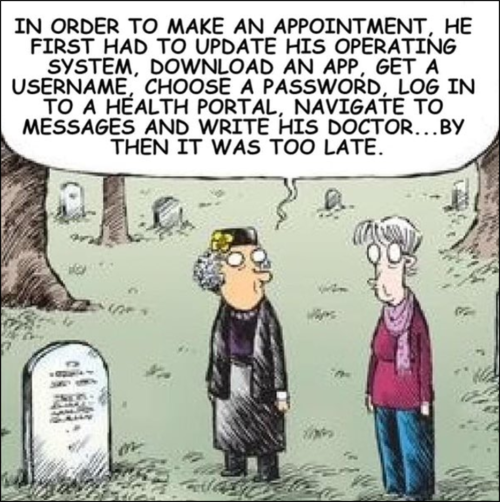
Today’s patient portals are a mess. The catchphrase “Your mom has 7 portals for 7 providers” sums up patients’ frustrations and the resulting tepid utilization of portals. Today’s portals CAN NOT capture network value.
The first post in this series introduced the platform terminology of single-homing vs. multihoming. Patients strongly would prefer to have as few portals as possible — ideally one, i.e., a single “home”. However, patients are forced to subscribe to multiple homes since today’s portals are tethered to individual institutions or care providers.
In this post, we’ll introduce the platform terminology of stand-alone vs. network value. Today’s patient portals can provide some stand-alone value, but they provide minimal network value.
In the upcoming third post in the series, we’ll discuss “friction” in today’s portals. In the fourth post, we’ll consider some alternatives; while today’s portals CAN NOT work as configured, we’ll look at some options that could work.
Stand-Alone vs. Network Value
Value is created in different ways for different offerings. Some offerings provide stand-alone value; others provide value through networks and networked data and activities; some provide a combination of these.
Stand-alone value refers to the value provided by an offering that is independent of how the platform is used by others. Network value refers to value created through the activity and usage of others. Network value also refers to network effects or positive feedback loops created through the activities of others.
Let’s use your personal computer as an example to explain the difference between stand-alone vs. network value. Your PC has stand-alone value even when it is not connected to a network such as the internet.
Today’s Patient Portals CAN NOT Work: Friction ACROSS Portals
by Vince Kuraitis and Jody Ranck
Friction across multiple patient portals dramatically limits their usefulness—there’s no practical way for patients OR providers to reconcile and integrate information and workflow.
This is the third post in our series on patient portals. We’ve used platform terminology and concepts to explain why today’s patient portals are doomed to mediocrity. Let’s recap:
The first post in this series introduced the platform terminology of single-homing vs.multihoming. Patients strongly would prefer to have as few portals as possible — ideally one, i.e., a single “home”.
The second post described the difference between stand-alone value and network value. Today’s patient portals can provide some stand-alone value, but they provide minimal network value.
In this post we’ll discuss the pitfalls of friction across multiple portals. Your mom having seven portals is more than just inconvenient—it’s dangerous.
The Missing Ingredient in Today’s Patient Portals: Network Effects
by Vince Kuraitis and Jody Ranck
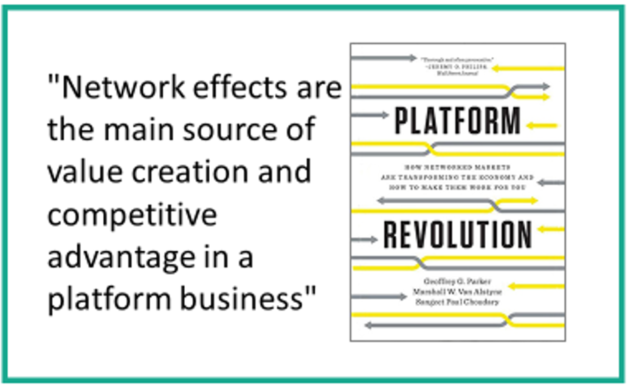
As described in the first three posts in this series, today’s patient portals are inherently flawed and doomed to mediocrity. The result is that today’s patient portals cannot achieve a critical mass of adoption and utilization, and therefore portals can’t achieve network effects.
In this post, we will:
- Summarize key points from the first three posts in this series
- Explain how today’s patient portals miss out on three types of network effects
- Explain the implications: why tomorrow’s portals must be reconfigured to achieve network effects
Summarizing
Let’s review some of the key points from the first three posts in this series.
Patients would prefer one portal “home” (from the 1st post in this series):
By definition, today’s portals are NOT patient-centric—they are tethered to individual provider organizations.