Subscribe if you want to be notified of new blog posts. You will receive an email confirming your subscription.

Big Tech’s Platform Playbook in Healthcare: It’s the Data, Stupid
An excellent journal article provides an in-depth exploration of how Big Tech platforms have entered highly regulated industries such as healthcare and education:
“…the crux of platform entry into highly regulated markets is access to sensitive data.”
The article is entitled “Digital Colonization of Highly Regulated Industries: An Analysis of Big Tech Platforms’ Entry into Health Care and Education“. It was published in the California Management Review on May 24, 2022. The 30 page full-text is available as an open-access .pdf.
The authors researched and analyzed the activities of Google (Alphabet), Apple, Facebook (Meta), Amazon and Microsoft in the U.S. and U.K. Their research revealed over 3,500 articles shedding light on how these companies approached healthcare.
I’ll briefly summarize the article, point out its strengths, and comment on how the title of “Digital Colonization” misses the mark.
Inaugural MIT Conference: The Platform Revolution Comes to Healthcare
The first conference event to focus on digital platforms in healthcare! Attend in-person or virtually — the afternoon of July 13, 2022.
“The Platform Revolution Comes to Healthcare: A Deep Dive at the 2022 MIT Platform Strategy Summit”
The MIT Initiative on the Digital Economy is excited to announce this inaugural 1/2 day event leading into the 10th Annual MIT Platform Strategy Summit the following day, on July 14. Through several feature keynotes and panel sessions involving industry experts, this event is designed to explore how digital health platforms are key enablers of transformation in healthcare.
Confirmed speakers and panel members include:
* Jonathan Bush, CEO, Zus Health
* Nancy G. Brown, General Partner, Oak HC/FT
* Michael Byczkowski, Global VP, Head of Healthcare, SAP
* Michael Cantor, Chief Medical Officer, Uber Health
* William Febbo, CEO, OptimizeRx
* Adam Grossman, Partner, Deerfield Management
* Christian Howell, VP & GM, Aetion
* Seth Joseph, Managing Partner, Summit Health
* Vince Kuraitis, Principal, Better Health Technologies
* Jeff Loucks, Executive Director, Deloitte Center for Technology, Media, and Telecommunications
* Geoff Parker, Professor, Dartmouth College MEM and co-author of “Platform Revolution”
* Roy Schoenberg MD MPH, President & Co-CEO, Amwell
* Robert Sepucha, CEO, Cricket HealthMark A. Johnston
* Micky Tripathi, National Coordinator for Health IT, Office of the National Coordinator for Health Information Technology (ONC)
* Randall Williams, MD, Digital Care Advisors
Three panel sessions will focus on:
* Investment in digital platform businesses
* Value creation from data
* Consumerism and healthcare platform businesses
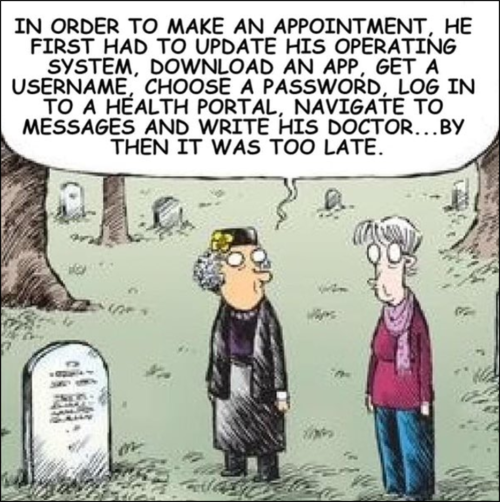
Today’s Patient Portals CAN NOT Work: An Inability to Capture Network Value
by Vince Kuraitis JD/MBA and Jody Ranck DrPH
Today’s patient portals are a mess. The catchphrase “Your mom has 7 portals for 7 providers” sums up patients’ frustrations and the resulting tepid utilization of portals. Today’s portals CAN NOT capture network value.
The first post in this series introduced the platform terminology of single-homing vs. multihoming. Patients strongly would prefer to have as few portals as possible — ideally one, i.e., a single “home”. However, patients are forced to subscribe to multiple homes since today’s portals are tethered to individual institutions or care providers.
In this post, we’ll introduce the platform terminology of stand-alone vs. network value. Today’s patient portals can provide some stand-alone value, but they provide minimal network value.
In the upcoming third post in the series, we’ll discuss “friction” in today’s portals. In the fourth post, we’ll consider some alternatives; while today’s portals CAN NOT work as configured, we’ll look at some options that could work.
Stand-Alone vs. Network Value
Value is created in different ways for different offerings. Some offerings provide stand-alone value; others provide value through networks and networked data and activities; some provide a combination of these.
Stand-alone value refers to the value provided by an offering that is independent of how the platform is used by others. Network value refers to value created through the activity and usage of others. Network value also refers to network effects or positive feedback loops created through the activities of others.
Let’s use your personal computer as an example to explain the difference between stand-alone vs. network value. Your PC has stand-alone value even when it is not connected to a network such as the internet.

Platform Terminology Explains Why Today’s Patient Portals CAN NOT Work
“…the patient portal, as currently architected, is a complete dead-end.”
—John Moore, Founder and Managing Partner, Chilmark Research
Patient portals have tremendous potential — but that potential has not been realized and *CAN NOT* be realized as portals are currently configured.
An understanding of platform business models and strategy explains why today’s patient portals are inherently suboptimal.
This essay is the first in an occasional series that will look at patient portals through the lenses of platform business models and strategy. Today’s post will introduce and explain platform terminology of multihoming and single homing. Future posts will look more deeply into “why” current patient portals can’t work and will propose options for portals that could work for patients.

Briefly Characterizing Today’s Patient Portals

Gist Healthcare’s 4-Episode Podcast Series: “Toward a Platform Future”
Gist Healthcare has concluded their 4-Episode podcast series: “Toward a Platform Future”. Kudo’s to organizer and moderator Alexandra Olgin.
Here’s a brief summary and links to each episode:
Randy Williams, Digital Care Advisors, LLC; Vince Kuraitis, Better Health Technologies, LLC
An overview and introduction to the growing popularity of the platform business model in healthcare and the current state of the market. Topics include defining a platform, “platform thinking”, threats and opportunities for incumbents, the rise of virtual care platforms.
Chas Roades and Lisa Bielamowicz, co-founders of Gist Healthcare
Health systems are vertically integrating to create care ecosystems to build consumer loyalty and fend off competition from disruptors.
Derek Streat, CEO, DexCare
The Providence health system spinout is now offering its digital operating system to other health systems to help connect point solutions.
Seth Joseph, Managing Partner, Summit Health
A profile of the poster child for healthcare platform success – Surescripts. Despite the common perception that platform businesses are overnight success stories, he says it’s actually been a slower road for most to gain traction and realize growth.

Amazon is Uniquely Positioned to Deploy Platform Envelopment Strategies in Healthcare: 7 Leverage Points (Part II)
In Part I of this series, we defined platform “envelopment” strategies. In short, platform companies can leverage an existing user base and existing capabilities into new markets. We then documented seven of Amazon’s leverage points in potentially deploying envelopment strategies in healthcare:
- A Huge User Base
- A Loyal User Base
- Provision of Hybrid Clinical Care
- Deep Pockets
- A National and International Footprint
- One-Stop-Shopping for Employers?
- Digital Front Door for Healthcare?
In Part II of this series, we take these seven leverage points and compare Amazon’s ability to deploy envelopment strategies with companies in five other sectors of healthcare:
- Virtual care platforms
- Other Big Tech
- Retail Pharmacy
- Other Big Retail
- Regional health systems
As we noted in Part I, “envelopment” originally refers to a military flanking maneuver — an attack to the side or rear that avoids the enemy’s frontal strengths. Our intent is to illustrate the power of platform envelopment strategies and to specify some of Amazon’s potent options. We’re not forecasting Amazon’s success, and we’re not suggesting competitors are defenseless — they have many other strategic options.
Amazon’s Leverage Points to Deploy Envelopment Strategies: A Comparison
The graphic below summarizes our perspectives of Amazon’s leverage points and how these leverage points line up against major competitors. We set a 5 year time horizon.

Amazon is Uniquely Positioned to Deploy Platform Envelopment Strategies in Healthcare: 7 Leverage Points (Part I)
by Vince Kuraitis, JD/MBA and Randy Williams, MD
Last week Amazon announced that “Amazon Care’s virtual health services are now available nationwide—and in-person services will be rolled out in more than 20 new cities this year.” We observe Amazon methodically developing services initially for its own employees and other employers, and potentially positioning itself to serve mass consumer markets.
How is Amazon doing this? Platform “envelopment” is one of the most powerful tactics in the platform strategy playbook. In Part I of this series, we define the term, briefly describe Amazon’s expansion into healthcare, and describe seven of Amazon’s leverage points for employing envelopment strategies. In Part II, we’ll compare Amazon’s ability to leverage these envelopment strategies with companies in five other healthcare sectors.
We’re not privy to Amazon’s long-term healthcare strategy. We want to be clear that what we’re describing is our view of Amazon potential, based on our understanding of what we read and hear.
What is Platform “Envelopment”
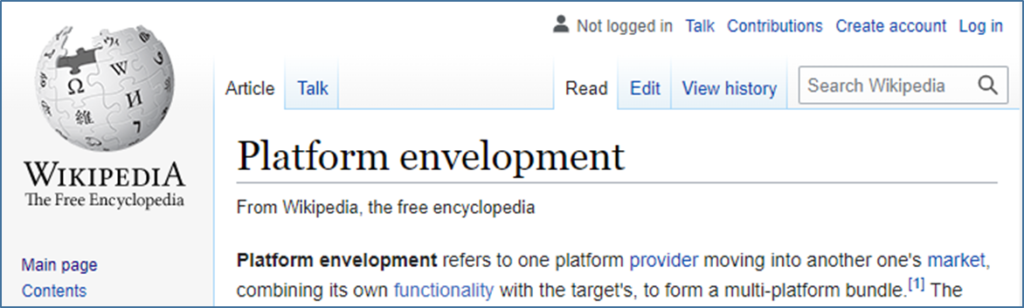
The term “envelopment” derives from military strategy. It’s a flanking maneuver — an attack to the side or rear that avoids the enemy’s frontal strengths.
The term “platform envelopment” describes how one digital platform attacks an adjacent market. In plain English, platform companies can leverage an existing user base and existing capabilities into new markets.
Gist Healthcare Podcast: Toward a Platform Future
Randy Williams, MD and I were interviewed about platform business models and strategy by Alexandra Olvin of Gist Healthcare. This is the first podcast in a four-part series: “Toward a Platform Future.”
We discuss the growing popularity of platform business model in healthcare, and what it might mean for the industry:
- “Platform thinking” for healthcare
- Defining a platform
- Companies best positioned for platform business models
- Threats and opportunities for incumbent health systems
- The rise of virtual care platforms

Chilmark Podcast–Platform Thinking for Healthcare: A Discussion with Vince Kuraitis and Randy Williams
Dr. Randy Williams and I were interviewed by Jody Ranck of Chilmark Research. We discuss platform thinking for healthcare. Chilmark’s article contains a link to the podcast, a summary, and an “AI-generated” transcript.
Here are a few choice quotes from the podcast:
Vince: “EHRs are the poster child for a lack of platform thinking in health care”
Randy: “traditional business models really produce products and services, and they do that through taking the production side, integrating that and ultimately selling and delivering a product or a service to a customer….platform businesses really contrast with these traditional pipeline businesses by unlocking new sources of value both on the creation side of a transaction but also on the consumption side. Their function is really to facilitate matches or to consummate exchanges of goods and services, thereby creating value for all the parties.”

Platforming Mental Healthcare: Investors Create New “Mental Models”
by Randy Williams, MD and Vince Kuraitis, JD
One sector at this year’s JP Morgan Health Care Private Equity Conference caught our attention: the virtual mental health market. Six months ago, market leader Headspace Health announced a $6 billion merger with Ginger to create perhaps the largest mental health platform business to date. Headspace announced yet another acquisition, this time with the Y Combinator incubated start up, Sayana. The combined companies support the mental health and wellness needs of over 100 million individuals.
Many others are joining the investment opportunity of tech enabled mental health. This past year alone, investors poured $5.5 billion into the space, up over 130% from 2020 according to CB Insights.
“Mental Models” Shape Our Thinking
The Headspace/Sayana merger announcement has us thinking…is it time for a broader “mental” model reset in healthcare? (Pun definitely intended).
As in any industry, healthcare leaders use mental models to frame their thinking about the current state and how to envision tomorrow. Mental models are useful tools that help us understand and act within complex systems. They not only shape what we think and how we understand but they shape the connections and opportunities that we see.